

The best-known multilingual plugins on the market each have their strengths, but also well-documented limitations. They are often based on inherited logics: page duplication, complex workflows, strong technical dependency or pricing models that are difficult to anticipate over time.
The Tricot multilingual plugin has been designed to address these irritants, taking into account the current reality of WordPress sites and modern expectations in terms of artificial intelligence and human intervention in translation.
Tired of WPML and other frustrating alternatives for translating your WordPress site? Here are four fundamental reasons why Tricot stands out today as the multilingual plugin best suited to your needs:
- Humans have the last word in translation
- An plugin developed for non-technologists
- Your site always up to date, in every language
- Predictable, transparent costs
1. A WordPress plugin that values human intervention in translation
Machine translation has profoundly transformed multilingualism. Today's tools, notably DeepL, offer impressive machine translation quality for a wide variety of content. The problem is no longer access to AI, but how it is integrated into an overall quality process.
For the multilingual plugins on the market, machine translation is sometimes ignored, sometimes treated as an end in itself.
With the Knitting pluginArtificial intelligence is a gas pedal in translation, but the human being remains in control at all times.. The system is designed to facilitate human intervention, whether by an in-house team or by external professional linguists.
The intuitive interface enables rapid editing and validation, the dashboard always informs the user of the percentage of AI translations awaiting verification, and it's even possible to export all content for review by professional translators (of course, then import without technical friction!).
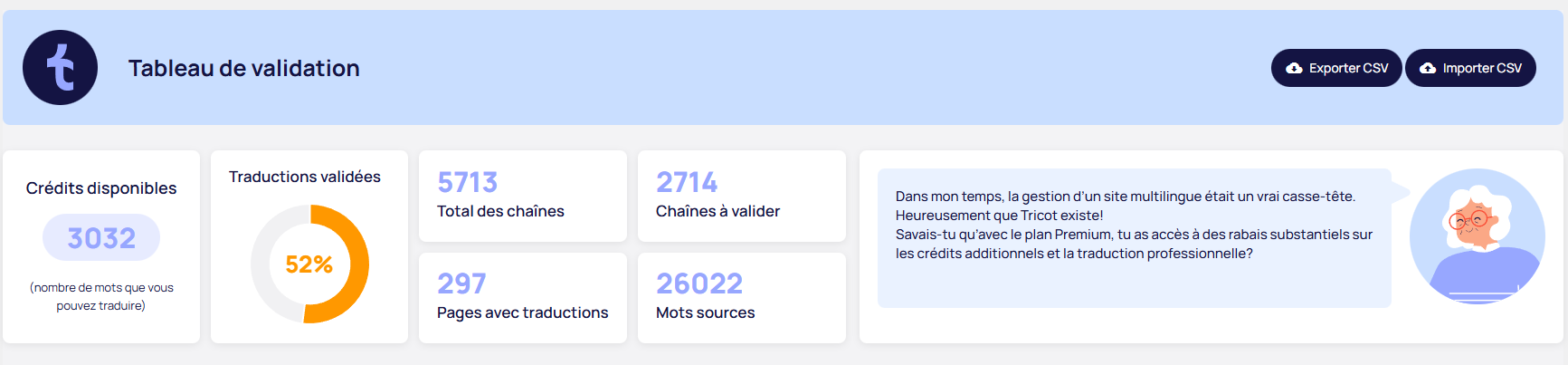
Conversely, an alternative like WPML often relies on more rigid workflows, where translation management is closely tied to the site's page structure. This complicates collaboration with external language professionals and makes round-trips more cumbersome.
With Tricot, human linguistic validation is not an option. It is built into the very architecture of the tool.
2. An plugin developed for non-technologists
Agencies and customers are constantly reminded that multilingual plugins are all too often designed by and for developers. As a result, your teams are continually dependent on a Web provider for simple actions, such as correcting a label or modifying a section of your site.
Tricot was designed from the outset to be usable by non-technologists. The interface is deliberately sober, oriented towards the user's main task: validating AI-generated translations. Actions are self-explanatory, terms are understandable and user paths are short.

This approach contrasts with WPML, whose complexity is accompanied by a steep learning curve. Configuration is laborious, options are abundant and the internal logic requires initial training and support.
For agencies, the simplicity of the Tricot plugin means less technical support, less training and greater customer autonomy. For customers, it means real control over their multilingualism, without constant dependence on experts.
3. Your site always up to date, in every language
A multilingual WordPress site is never static. New articles are published, pages are updated, calls to action evolve, marketing campaigns are launched. Every change is an opportunity to create gaps between languages if the structure doesn't keep up.
Tricot has been designed to support this natural evolution by managing the entire multilingual aspect for you. When source content is modified, the system instantly identifies the segments that need to be re-translated and validated. Maintenance of other languages becomes an automated process supported by AI. Just check the generated translations whenever you like!
With WPML, multilingual maintenance is often perceived as an additional burden. Teams are reluctant to modify pages for fear of breaking links between languages or getting content out of sync.
The ease of maintenance offered by Tricot is particularly appreciated by agencies, who are looking to reduce post-delivery costs, and by customers, who want a site that can evolve without increasing complexity.
Tricot's approach allows sites to age more serenely. Partial redesigns, content adjustments or SEO optimizations don't become multilingual projects in themselves. They remain simple actions, applied to a stable structure.
4. Predictable, transparent costs
The cost of a multilingual plugin is never limited to its initial purchase price. You need to consider installation and configuration time, translation costs, maintenance, adjustments... Over a three- to five-year horizon, the differences become significant.
With Tricot, setting up and configuring the plugin takes literally minutes. The tool detects the site's content, suggests an automatic translation that positions itself in a page that accurately reflects the source version, and displays the segments for verification in the validation table. We're talking minutes, whatever your level of fluency with WordPress! This ease of use contrasts with WPML, where configuration is long and laborious, involving the creation of new pages. You'll see the difference in cost!
The Knitting plugin offers a clear, predictable model for both the web provider and the customer.
The license is invoiced annually and includes a bank of credits to activate automatic translation.
- The PRO license ($260) is ideal for getting started: it includes all the essential features needed to efficiently manage a multilingual site, plus a bank of 7,000 credits.
- The PREMIUM license ($486) goes even further, with advanced features that optimize human intervention, such as content import/export and contextual editor, plus a bank of 70,000 credits.
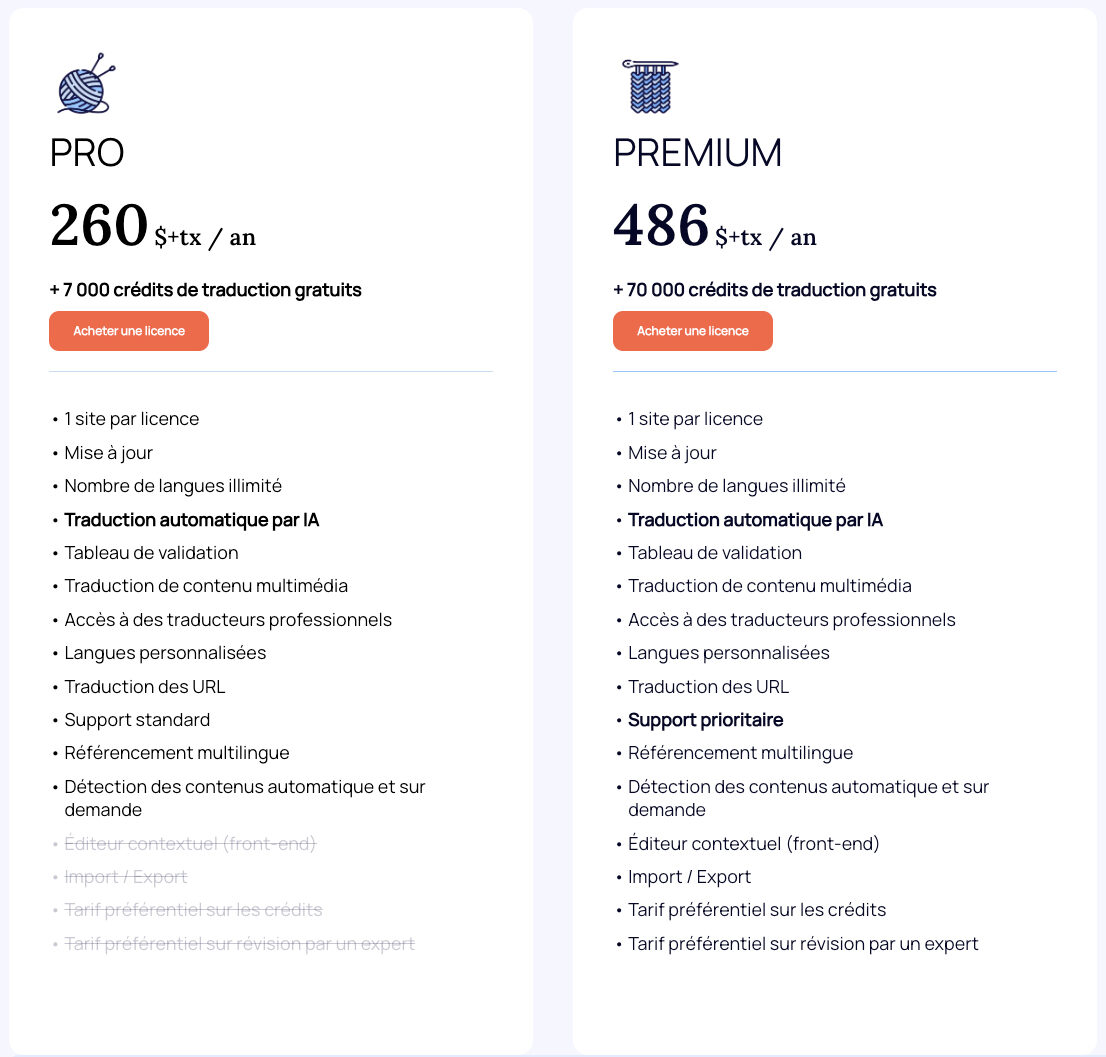
How do credits work?
Credits activate the automatic translation of your content. The calculation is simple: one credit translates one word! If the bank of credits included with your license isn't enough, you can purchase more at a low cost ($0.00098/word).
So... how much does it cost?
For a small site, the PRO license is ideal, at $260 per year. For a larger site, the PREMIUM license is preferable, at $486 per year.
If you have more than 70,000 words on your site, you may need a block of credits.
To estimate the number of words of your website to be translated, insert your URL in our word calculatorit's easy and free!
Oh! Unlike some well-known multilingual solutions, translations are stored locally with Tricot, with no dependence on an external platform for reuse. This ensures that you can keep your translations even if you terminate your paid subscription.
Over the long term, Tricot offers lower total cost of ownership, greater budget predictability and greater independence for organizations.
An plugin aligned with the reality of multilingual WordPress
Tricot seeks to solve concrete problems encountered daily by agencies, SMEs and content teams. By valuing human validation in an AI-accelerated approach, simplifying the user experience, easing maintenance and offering a transparent pricing model, Tricot is part of a sustainable vision for multilingualism on WordPress.
In an ecosystem where complexity is often presented as a guarantee of power, Tricot makes the opposite bet: consistency, simplicity and long-term control.
